Claude Opus 4.6 delivers a step‑change in reliability and intelligent autonomy, combining a million‑token context window (beta), adaptive thinking, and powerful agentic capabilities in one premium model.
Claude 4.6 Opus is the flagship model in the Claude 4 generation, engineered to handle demanding cognitive workloads that exceed the capabilities of standard large language models. It is optimized for scenarios where precision, consistency, and extended reasoning matter more than speed alone.
Unlike lighter models focused on conversational tasks, Claude 4.6 Opus excels at end-to-end execution: understanding complex inputs, maintaining context over long sessions, and producing structured, high-quality outputs suitable for real-world deployment.
Input
Output
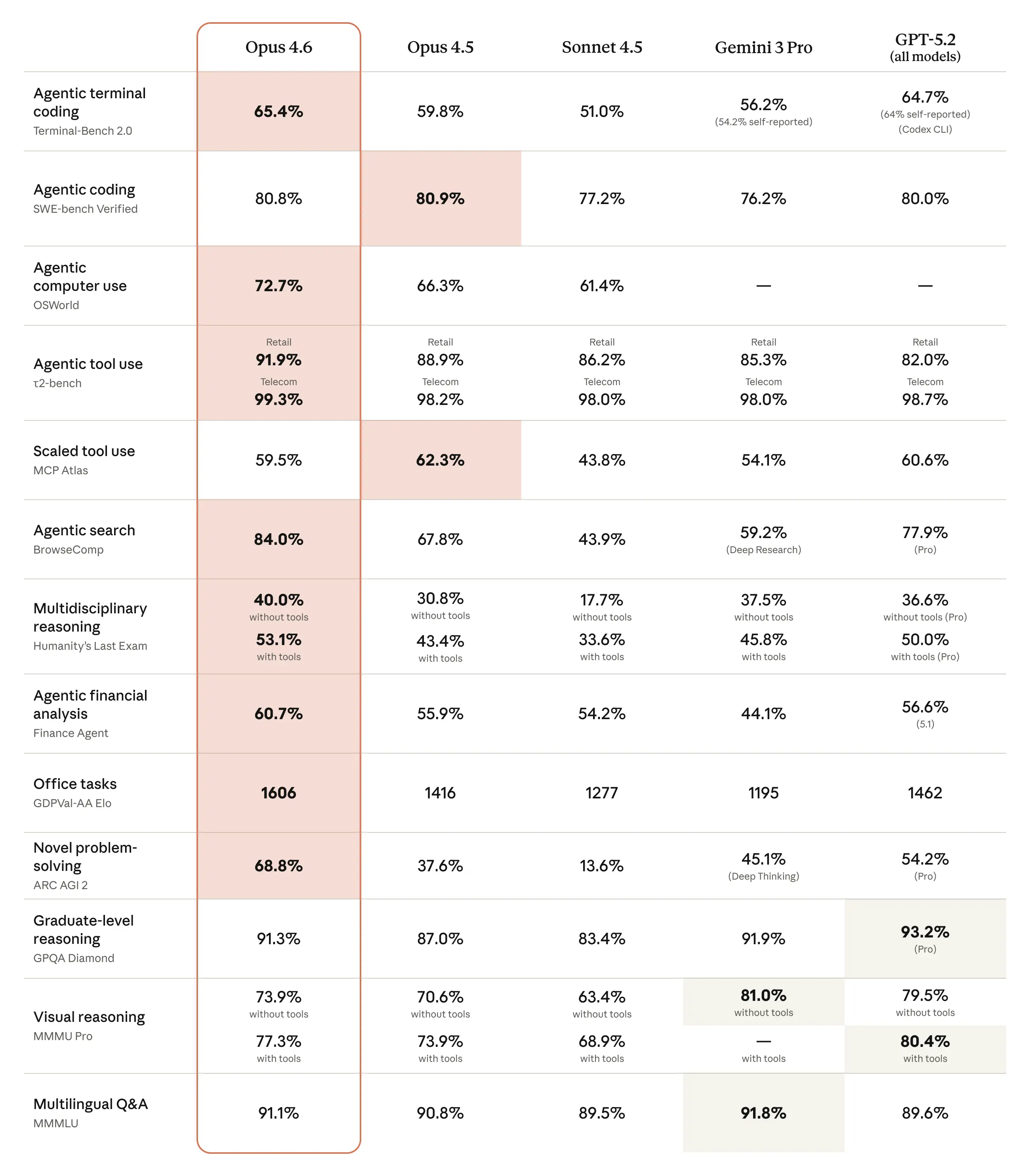
Opus 4.6 is tuned to read the full picture before acting, mapping file structures, dependencies, and patterns so it can plan multi‑step solutions instead of producing shallow, one‑shot answers. It stays with hard problems longer, explores alternatives independently, and commits to a direction once it has enough context, making it suitable for nuanced product, technical, and organizational decisions.
Opus 4.6 delivers production‑ready code with stronger code review, debugging, and large‑codebase navigation than earlier Claude models. It scored at the top of coding evaluations like Terminal‑Bench 2.0 and is designed to autonomously close issues, manage repositories, and coordinate multi‑repo tasks with minimal human hand‑holding.
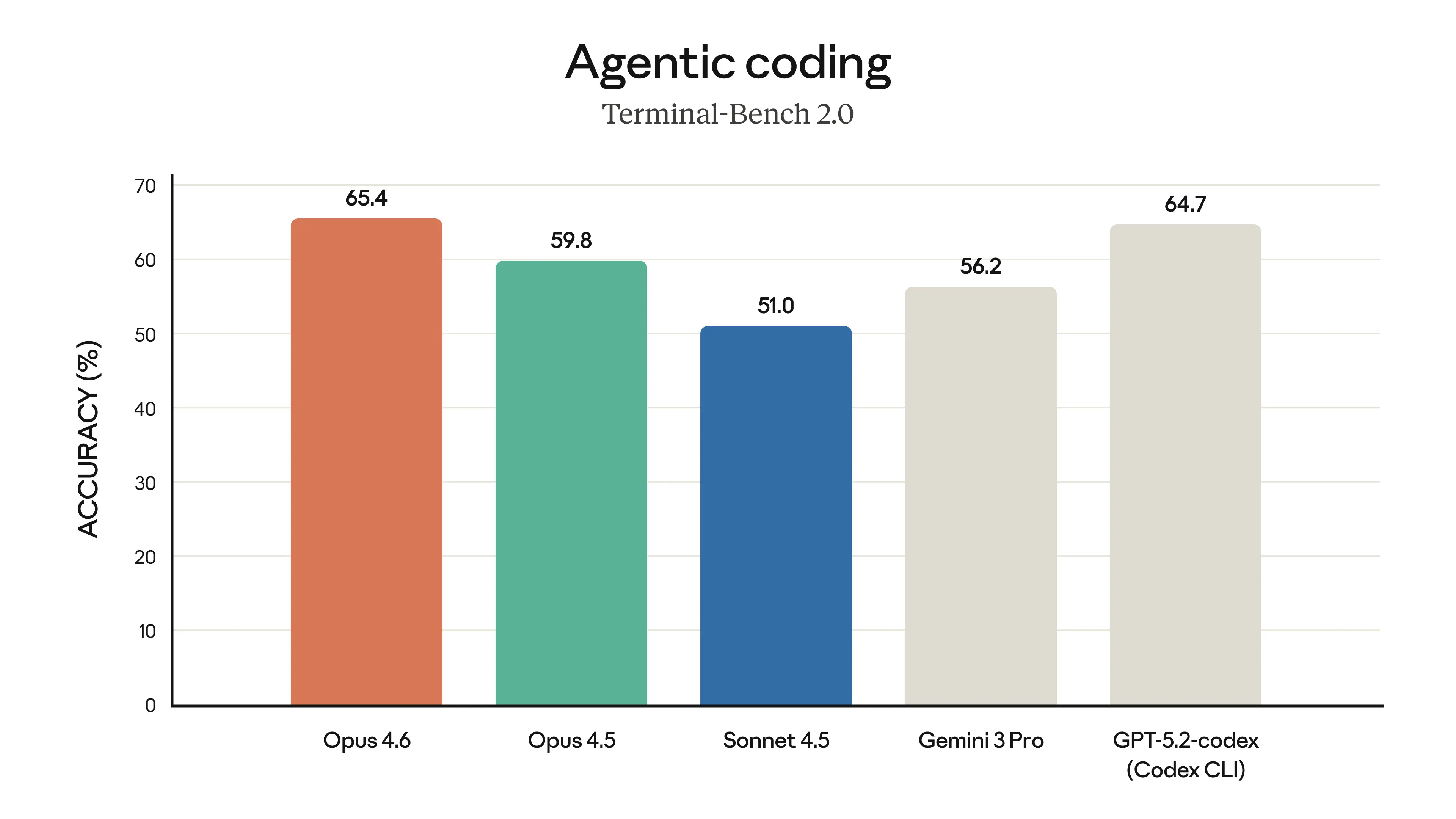
The model excels at agentic terminal coding, computer use, and sophisticated tool calling, enabling workflows where it operates software, searches, and internal tools on your behalf. Features like agent teams let multiple Claude Code sessions collaborate on complex tasks, while adaptive thinking decides when to invest more reasoning effort versus returning faster answers.
Claude Opus 4.6 can draft, refine, and orchestrate complex documents such as financial analyses, research syntheses, polished decks, and interactive product specs. With tight integrations for Excel and a research preview for PowerPoint, it can pull data from connected tools, chase leads across sources, and assemble presentations or models that reflect the actual underlying information.
Anthropic recommends giving Opus 4.6 rich initial context, goals, constraints, examples, and definitions, so it can build an accurate mental model before acting. For complex workflows, you get better results by asking it to outline a plan, validate assumptions, and then execute the plan step by step with checkpoints.
Measured on the AI/ML API gateway across live traffic. Figures are medians unless stated. Last updated 2026-10-12.
Claude Opus 4.6 is documented as suited to coding, enterprise agents, and professional work, including complex coding projects and multi-step development tasks.
It is also suited to financial analysis, where it can synthesize regulatory filings, market reports, and internal data into insights.
The model is documented for research and document-heavy knowledge work, including pulling relevant information from large document sets and creating documents, spreadsheets, and presentations.
It is also suited to agentic workflows and computer use, handling complex multi-step tasks across many tools and visual interfaces with reliability.
import requests

r = requests.post(
    "https://api.aimlapi.com/v1/chat/completions",
    headers={"Authorization": "Bearer " + AIMLAPI_KEY},
    json={
      "model": "anthropic/claude-opus-4-6",
      "messages": [
        {
          "role": "user",
          "content": "Hello!"
        }
      ]
    },
)
print(r.json())
const r = await fetch("https://api.aimlapi.com/v1/chat/completions", {
  method: "POST",
  headers: {
    Authorization: `Bearer ${process.env.AIMLAPI_KEY}`,
    "Content-Type": "application/json",
  },
  body: JSON.stringify({
    "model": "anthropic/claude-opus-4-6",
    "messages": [
      {
        "role": "user",
        "content": "Hello!"
      }
    ]
  }),
});
console.log(await r.json());
curl -X POST https://api.aimlapi.com/v1/chat/completions \
  -H "Authorization: Bearer $AIMLAPI_KEY" \
  -H "Content-Type: application/json" \
  -d '{"model":"anthropic/claude-opus-4-6","messages":[{"role":"user","content":"Hello!"}]}'
OpenAI-compatible — swap the base URL and it works with your existing SDK.
| Type | Price |
|---|---|
| Input | |
| Output | |
| Cached input |
| Benchmark | Score | What it measures | Source | Retrieved |
|---|---|---|---|---|
| GPQA Diamond | 91.3% | Google-proof graduate science questions (hardest subset) | Source | July 8, 2026 |
| OSWorld | 72.7% | Computer-use across real desktop applications | Source | July 8, 2026 |
| Terminal-Bench | 65.4% | Autonomous shell/terminal task completion | Source | July 8, 2026 |
| SWE-bench Verified | 80.8% | Resolving verified real GitHub issues | Source | July 8, 2026 |
| Intelligence | 31.9 | Composite score across standardised reasoning, knowledge and problem-solving evaluations, measured independently by Artificial Analysis | Source | September 12, 2026 |
| Model | Input | Output | Context | Best for |
|---|---|---|---|---|
Claude Opus 4.6 This page | Chat + assistants | |||
| Chat + assistants | ||||
| Balanced coding + agents | ||||
| Reasoning + agents | ||||
| Reasoning + agents with long context |
Claude Opus 4.6 has a 200,000 tokens context window and can return up to 128,000 tokens.
Claude Opus 4.6 takes text as input and returns text.
Use anthropic/claude-opus-4-6 as the model id. Requests go to https://api.aimlapi.com/v1/chat/completions.
Claude Opus 4.6 became available on February 6, 2026.
Claude Opus 4.6 is priced at input $6.5 / 1M tokens, output $32.5 / 1M tokens, cached input $0.65 / 1M tokens.
Yes, Claude Opus 4.6 can stream responses as they are generated.
Claude Opus 4.6 was built by Anthropic.