

GLM-5.4 vs Claude Opus 5.5 for Coding: Can You Switch?
Hit your Claude usage limit before the job is done? But your product still has to ship, so what would you do? We ran GLM-5.4 and Claude Opus 5.5 on three coding jobs to find out. Each model got the same prompt and, for the job that starts from existing code, the same files. The jobs were finishing a Ferry Desk branch that failed one of four Node tests and clipped its Board party button at phone width, writing a Python seat-allocation function that a grader checks against eight cases, and building a one-file harbor page that has to run offline. Both models ran the same three jobs. The interactive demos below let you try the Ferry Desk booking flow and the harbor crossing yourself. The prompt named the clipping defect, and we didn't test whether a live Claude chat transfers.
TL;DR
Here is what 60 minutes of the same three coding jobs on both models showed — and what it costs you:
On November 24, 2026, we ran both models through OpenCode: GLM-5.4 on the Z.ai Coding Plan and Claude Opus 5.5 through AI/ML API as anthropic/claude-opus-5-5.
How did GLM-5.4 do in our coding tests?
Try the Ferry Desk demos and the harbor demos below.
We sent each task in a fresh session through the same OpenCode client, with no tools or web access. On Ferry Desk, both models got the same five serialized starter files in the same order and the same PNG as a separate attachment. For each of the two standalone coding tasks, they got only the same task prompt. We checked the requests OpenCode sent. Both specified low reasoning effort. GLM's branch and Python runs listed an 8,192-token output cap in the client configuration; no matching benchmark cap was set for Opus.
For the harbor showcase, we used the original-prompt follow-up runs without that shared 8,192-token target. AI/ML API's route docs describe Opus 5.5's thinking as always on and adaptive, and the two vendors don't calibrate that setting to each other. OpenCode adds its own system instructions and reports the model ID you configured, so we confirmed the Opus route with a separate direct request, which returned claude-opus-5-5. These are two setups, not a controlled model-only comparison.
Ferry Desk: both patches passed the handoff checks
Both models changed only boarding.mjs and styles.css. Each accepted exact-fit parties, and one click on Board party took the display from 1 seat left to 0 seats left and disabled the button. The starter passed three of four tests before either model ran; the exact-fit case failed. We applied each response over the same editor-authored commit, ran the unchanged Node tests, and checked both layouts in Chrome: the full button and counter were visible without overlap or horizontal scrolling at 390 CSS pixels, and the row stayed side by side at 1024 CSS pixels. A separate verification also checked 320, 480, 481, 599 and 600 CSS pixels; both controls remained visible and usable at each width.
GLM-5.4's patch makes the stacked grid the default and switches to two columns at 600 CSS pixels. Claude Opus 5.5's patch keeps the two-column grid as the default and stacks it at 480 CSS pixels and below, where the button takes the full row width. Opus 5.5 also sets min-width: 0 on the seat counter so it can shrink inside the grid. Both patches change < to <= in canBoard; GLM-5.4 adds a separate positive-remaining check that Opus 5.5 leaves out because the party must be positive and fit. Both passed at the widths we checked. Before you merge either, test the widths your users actually visit, especially above 480 and below 600 CSS pixels, where GLM-5.4 stacks the row and Opus 5.5 keeps two columns.
Reader template, not our exact test prompt:
Repo instructions: [relevant rules, test setup and files]
Failing command and output: [exact command and failure]
Allowed files: [paths the model may change]
Acceptance checks: [what to run, click and inspect before merging]
Before sending the note, use Z.ai's model-switch guide and `/status` check for Claude Code. If you're using OpenCode, use Z.ai's OpenCode setup guide and `/models` picker.
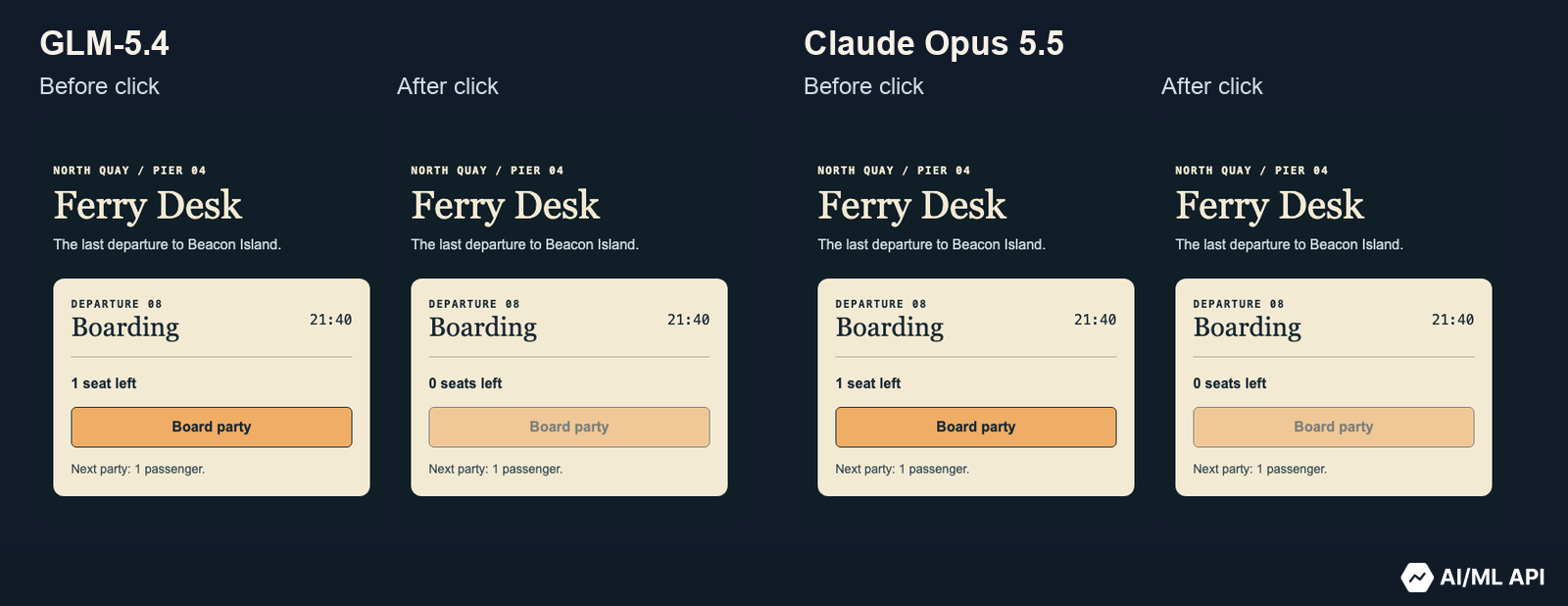
Ferry Desk at 390 CSS pixels, before and after the booking click.
Who Gets the Last Seat? Both passed eight Python cases
Both models returned plain Python and passed all eight tests. The grader checked priority, arrival order and ID ties, exact fit, skipping an oversized party, non-mutation and repeatability, among other cases. Neither model saw the grader. Both implementations sort a copy of the request list by priority, then arrival, then ID, and allocate seats in one pass. Those checks establish a tie on the supplied contract. They do not measure speed or maintainability.
The Last Ferry: two working harbor demos
The task was to build an offline harbor scene where one click on Send ferry would move the ferry to the opposite dock and leave it there. Both raw answers wrapped the HTML in Markdown fences, so both failed the HTML-only requirement. We removed only those fences to make the interactive demos. With network access blocked in Chrome, one click moved each ferry from the west dock to the east dock, where it stayed until any further interaction.
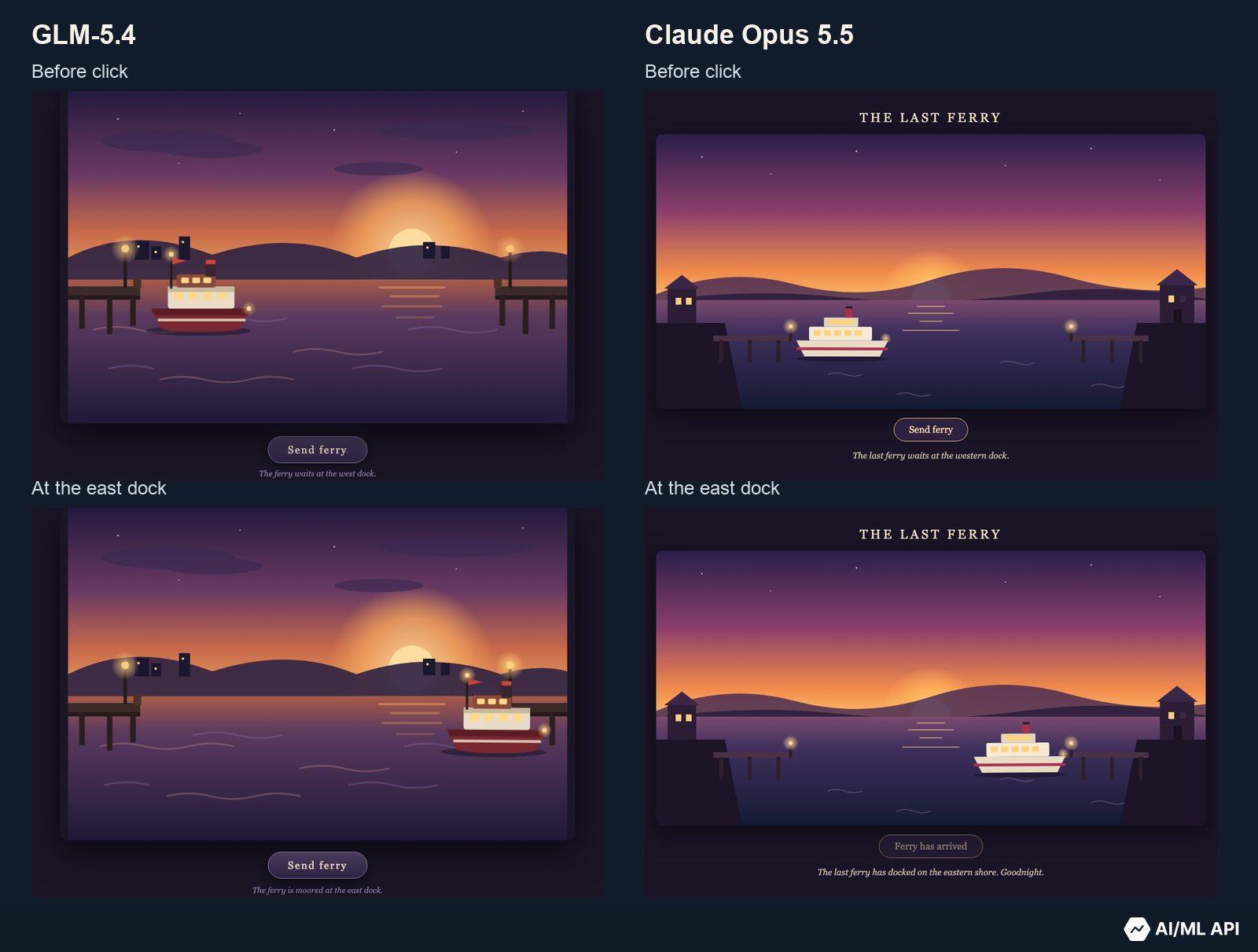
The Last Ferry before departure and after arriving at the east dock.
GLM-5.4 re-enables Send ferry after arrival; a second click sends the boat back west.
Claude Opus 5.5 changes the button to Ferry has arrived and leaves it disabled. If the scene should allow only one trip per page load, only the Opus demo does that.
What is GLM-5.4, and what changed?
GLM-5.4 is Z.ai's first flagship built on a Loop Transformer, announced November 23, 2026. A Loop Transformer runs the same block of layers more than once with shared weights, so an extra pass adds compute without adding a new set of weights for that block. Z.ai says GLM-5.4 runs 28 layers of the GLM-5 base model for two iterations.
Z.ai's model docs list image input. That doesn't guarantee that your client sends an attachment to the selected model. Both of our tested routes could read the same PNG: separate preflights identified "Boarding" and "1 seat left" from it. Check image delivery in your own setup before relying on a screenshot for a bug report.
GLM-5.4 vs Claude Opus 5.5: benchmarks
Coding benchmarks reported at Claude Opus 5.5's launch
Anthropic's Opus 5.5 announcement reports these three coding results. Z.ai's GLM-5.4 release reports a Loop Transformer experiment on a 30B test model, not scores for the released GLM-5.4 on these benchmarks.
Independent benchmark results
We found no GLM-5.4 entry in the Artificial Analysis model index or on the Vals AI and tbench.ai Terminal-Bench 4.1 leaderboards. These independent results describe Opus; they do not establish a head-to-head lead over GLM-5.4. The comparable checks in this article are the tasks we ran above.
GLM-5.4 pricing and availability
Checked November 24, 2026. Prices are in USD; token rates are per 1 million tokens.
Per 1M tokens, GLM-5.4's announced AI/ML API rates are about 30% of Claude Opus 5.5's input price and 19% of its output price. Opus has the lower listed cached-input rate.
Coding Plan five-hour limits: Lite 2,000 credits, Pro 12,000, Max 28,000. Those credits refresh five hours after use; weekly credits reset every seven days from activation.
How to repeat the handoff
Check the GLM-5.4 model page for AI/ML API availability. A model card or sign-in screen alone doesn't mean the API route is runnable.
FAQ
What is a Loop Transformer?
A Loop Transformer reuses the same weights each time it runs a block of layers. The extra pass adds compute without adding a second set of weights for that block.
How do I get access to GLM-5.4?
Use a supported tool with an active Z.ai Coding Plan. We verified OpenCode with that subscription route. Check the AI/ML API model card separately for API availability.
Can GLM-5.4 replace Claude Opus 5.5 for coding?
For one bounded handoff, yes: GLM-5.4 and Claude Opus 5.5 passed the same Ferry Desk booking and layout checks. The tests do not establish a replacement for multi-step agent work.
Which model should you use?
If your Claude usage is capped and the fix has a failing test, a short list of allowed files and clear acceptance checks, GLM-5.4 on the Coding Plan is a reasonable next attempt. For a broader refactor or a change with weak test coverage, keep the setup you already trust and narrow the diff to a change you can verify. These runs did not compare multi-step refactoring.
Try the same handoff on a disposable branch. Keep the first response, run your checks and decide from the patch whether you'd merge it.