
Ox Alpha: Benchmarks, API Access, and Who Built It
We've added Ox Alpha to AI/ML API. Here's everything you need to know about the new model.
What is Ox Alpha?
Ox Alpha is a new anonymous (“stealth”) AI reasoning model aimed heavily at coding, complex reasoning, and long-running AI-agent tasks. Its features: a 1,048,576-token context window, up to 131,072 output tokens, and support for text, images, and video as input. It also supports tool/function calling and structured output.
Right now, it is free on AI/ML API under the model ID stealth/ox-alpha.
Ox Alpha Main Features
Ox Alpha combines a large context window with multimodal input, extended reasoning, tool calling, and structured text output. Here are the model's main features:
| Specification | Value |
|---|---|
| model identifier | stealth/ox-alpha |
| release date | August 20, 2026 |
| release status | anonymous stealth preview |
| developer and operator | undisclosed third-party provider |
| primary use cases | coding, complex reasoning, sustained agentic work, and production workflows |
| context window | 1,048,576 tokens |
| maximum completion | 131,072 tokens |
| input modalities | text, images, and video |
| output modality | text |
| reasoning | supported; requests may include reasoning controls |
| tool calling | supported through tools and tool_choice |
| structured output | JSON output through response_format; JSON Schema enforcement is not documented |
| API format | OpenAI-compatible Chat Completions |
| AI/ML API endpoint | https://api.aimlapi.com/v1/chat/completions |
| authentication | Bearer API key in the Authorization header |
| required request fields | model and messages |
| output limit parameter | max_completion_tokens |
| provider routing | provider: "auto" uses the available fallback chain; a supported provider key can override it |
| preview token price | $0 per million input tokens and $0 per million output tokens |
| OpenRouter data handling | prompts and completions are retained by the provider but are not used for training |
We tested Ox Alpha
We tested Ox Alpha through AI/ML API with temperature: 0 and compared it with GLM, MiMo, and Qwen models. Here's what we found:
| Finding | What we measured | Why it matters |
|---|---|---|
| Same tokenizer as GLM | Ox Alpha counted all 8 test packs exactly like GLM-5.2 and GLM-5.3. GLM vision models matched 5 packs. MiMo and Qwen matched 2. | Ox Alpha most likely uses the same tokenizer as GLM-5.2 and GLM-5.3. |
| About 85 hidden input tokens | A four-token message used 91 prompt tokens. The extra tokens appeared on every repeated call. | Each request uses about 85 more input tokens than the prompt alone. |
| 35–39 tokens per second | Ox Alpha reached 35–39 tokens per second on two identical tests. GLM-5.3 reached about 69. | Ox Alpha was about twice as slow as GLM-5.3 in this test. |
| Speed changed during the hour | The reported median speed fell from 60.42 to 17.69 tokens per second in 45 minutes. The first token arrived after about 9–10 seconds. | Response time can vary a lot during the day. |
| Reasoning counted as output | A one-word answer used 36 completion tokens but reported zero reasoning tokens. GLM-5.3 counted 30 of its 35 tokens as reasoning. | Ox Alpha does not show how many tokens it spent thinking. |
It is widely thought that Ox Alpha is part of the GLM model family and our tokenizer test counted every test string exactly like GLM-5.2 and GLM-5.3. Thus, Ox Alpha most likely uses the same tokenizer as the GLM models.
Ox Alpha generated 35–39 tokens per second. GLM-5.3 completed the same task at about 69 tokens per second, so it was almost twice as fast.
Ox Alpha’s speed also changed during the session. Its median fell from 60.42 to 17.69 tokens per second in 45 minutes. The slowest one percent of requests grew from about 45 seconds to 131 seconds. A product using Ox Alpha should allow for these large swings.
How does Ox Alpha Perform? Benchmark Results
The table below shows how Ox Alpha performs in software engineering benchmarks:
| Benchmark | Ox Alpha result | Evaluation setup |
|---|---|---|
| Early DeepSWE sample | 8/10 tasks solved (80%) | Ten repository-level coding tasks; one recorded result per task for Ox Alpha |
| Full DeepSWE community run | 66/113 tasks solved (58.4%) | pier 0.3.1, mini-swe-agent, and a Docker backend |
| LiveCodeBench release_v6 | 49/175 problems solved (28.0% pass@1) | Greedy decoding, one attempt, no tools or agent scaffold |
| SlopCodeBench | 7/39 strict checkpoints passed (17.9%) | Eight cumulative repository-maintenance trajectories using pi 0.84.2 |
DeepSWE is a benchmark that closely mimics real-world software engineering. It contains 113 new tasks from 91 active open-source repositories in TypeScript, Go, Python, JavaScript, and Rust. For each task, the agent receives a repository and a change request. The benchmark then runs tests to check whether the change works.
In the first recorded public benchmark run, Ox Alpha solved eight of the ten requests, giving it an 80% completion score (Claude Fable 5 from Anthropic, for example, scored 65% and GLM-5.3 from Zhipu AI scored 62%).
However, on a larger run that included all 113 DeepSWE tasks, Ox Alpha completed 66 tasks, giving it a 58.4% completion score, often coming close on the remaining tasks. It passed at least 90% of the new tests on about 80% of all tasks. DeepSWE still counted an almost-correct task as a failure when even one required test failed. This explains how the model could make useful changes while finishing only 58.4% of the tasks.
Ox Alpha Vs. Other Models
The tables below show how Ox Alpha performs vs other models.
An independent Ox Alpha run solved 66 tasks. The official DeepSWE leaderboard reports higher scores for several competing models.
| Model | DeepSWE score | Source |
|---|---|---|
| Claude Opus 5 (max) | 74% ±4% | official leaderboard |
| GPT-5.6 Sol (max) | 73% ±3% | official leaderboard |
| Claude Fable 5 (max) | 70% ±4% | official leaderboard |
| GLM-5.3 (max) | 69% ±3% | official leaderboard |
| Claude Opus 4.8 (max) | 59% ±2% | official leaderboard |
| Ox Alpha | 58.4% (66/113) | independent community run |
Based on DeepSWE results, Ox Alpha performs similarly to Claude Opus 4.8.
SlopCodeBench tests if a model can keep working on the same project while keeping old features working. All three models below used the same 39-checkpoint set.
| Model | All tests passed | Current tests passed | Core task passed |
|---|---|---|---|
| GLM-5.3 | 11/39 (28.2%) | 17/39 (43.6%) | 26/39 (66.7%) |
| Ox Alpha | 7/39 (17.9%) | 10/39 (25.6%) | 21/39 (53.8%) |
| Qwen3.8-27B | 5/39 (12.8%) | 8/39 (20.5%) | 17/39 (43.6%) |
On this test, Ox Alpha falls behind GLM-5.3 — it often completed the core task, but later changes broke tests or missed edge cases. None of its eight projects passed every test at the final checkpoint.
Ox Alpha is a good coding generalist, but its performance begins to deteriorate over time while working on the same codebase.
Who built Ox Alpha
As of this writing, nobody has officially admitted to making Ox Alpha, but the technical evidence increasingly points toward Zhipu AI, now more widely known as Z.ai. Our own research above found the same clues.
Specifically, Ox Alpha could belong to their GLM-5 generation.
What we know so far
Ox Alpha first appeared on OpenRouter on August 20, 2026, under the model ID stealth/ox-alpha with this attribution:
it was developed and operated by a third-party provider that chose to remain anonymous.
However, independent researchers tested characteristics that are difficult for a model to fake and found that:
1. Its tokenizer is almost a fingerprint for GLM.
In one reproducible investigation, 44 out of 44 discriminating test strings matched the GLM-5-generation tokenizer exactly. Competing tokenizers performed noticeably worse: Qwen, OpenAI tokenizers, Kimi and DeepSeek all produced different results on multiple tests.
2. Ox Alpha appears to use Z.ai's server infrastructure.
Researchers deliberately sent malformed API requests to the service and one bad request caused the upstream system to reveal a Java class path:
com.wd.paas.api.domain.v4.chat.ChatCompletionRequest
This API structure can be linked to Zhipu/Z.ai's serving infrastructure. Ox Alpha also reportedly produced distinctive numerical error codes and message formats matching Z.ai-hosted GLM models.
3. Its video processing behaves like Zhipu's GLM vision models.
The video-token behavior of Ox Alpha matches GLM-5V-Turbo across several characteristics, including sampling behavior, video duration and resolution scaling. That suggests Ox Alpha may share not only a language-model tokenizer but also parts of Zhipu's multimodal processing stack.
4. Its reasoning controls resemble GLM-5.
Finally, Ox Alpha exposes reasoning levels such as low, high, and max, with reasoning essentially built into the model's operation. There are similarities between these controls and those documented for recent GLM models. Its context limits and output ceiling also line up well with GLM-5.
Fun fact: Ox Alpha isn't even the first “Alpha” model to follow this pattern. Previous anonymous models have eventually been revealed as models from companies including Chinese AI labs. For example, Zhipu's earlier Pony Alpha was eventually associated with GLM-5.
How to access Ox Alpha through AI/ML API
AI/ML API offers two ways to access Ox Alpha.
- In the Playground
- Through the API
Option 1: Test Ox Alpha in the Playground
- Sign in to AI/ML API and open the Playground.
- Select Playground in the left sidebar.
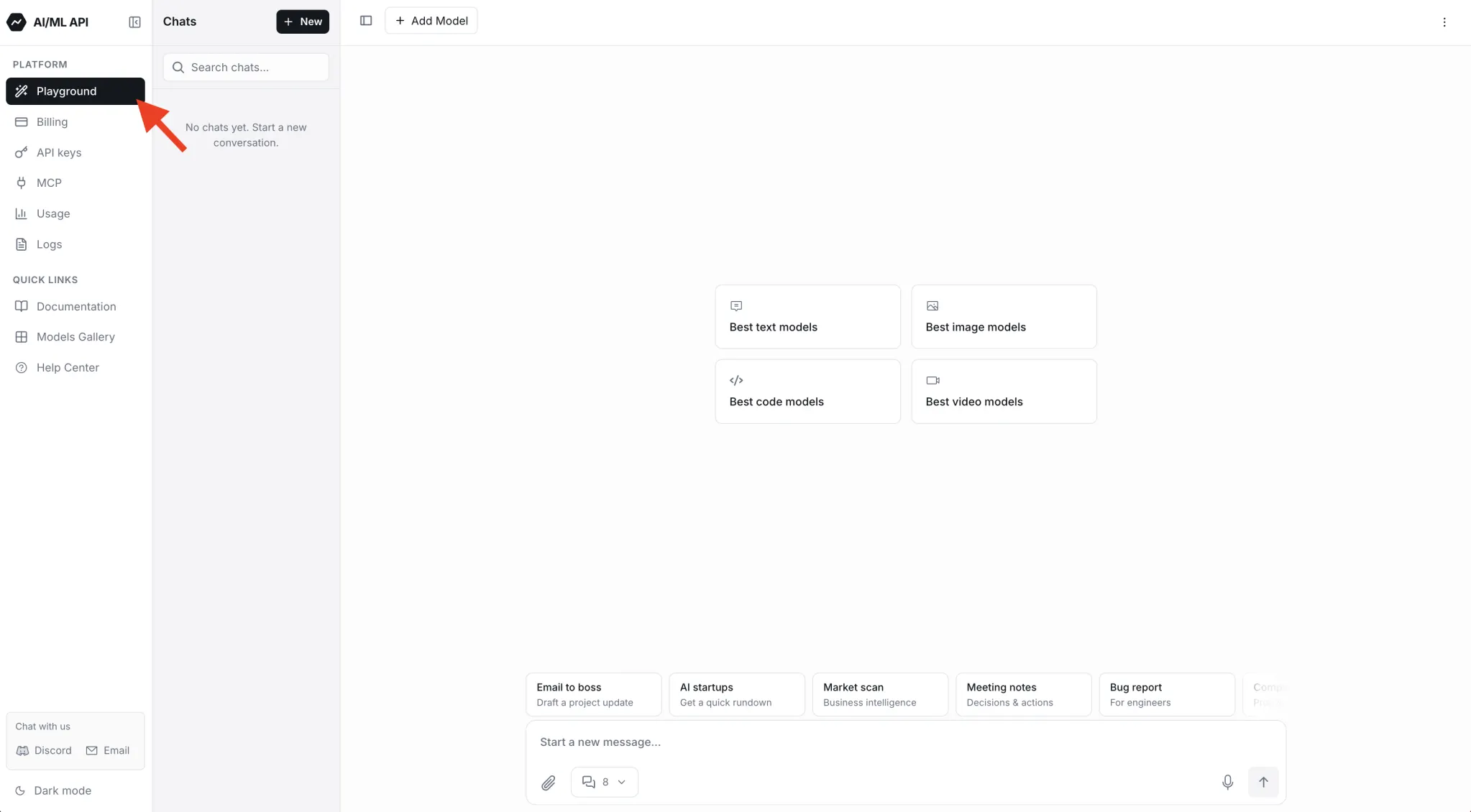
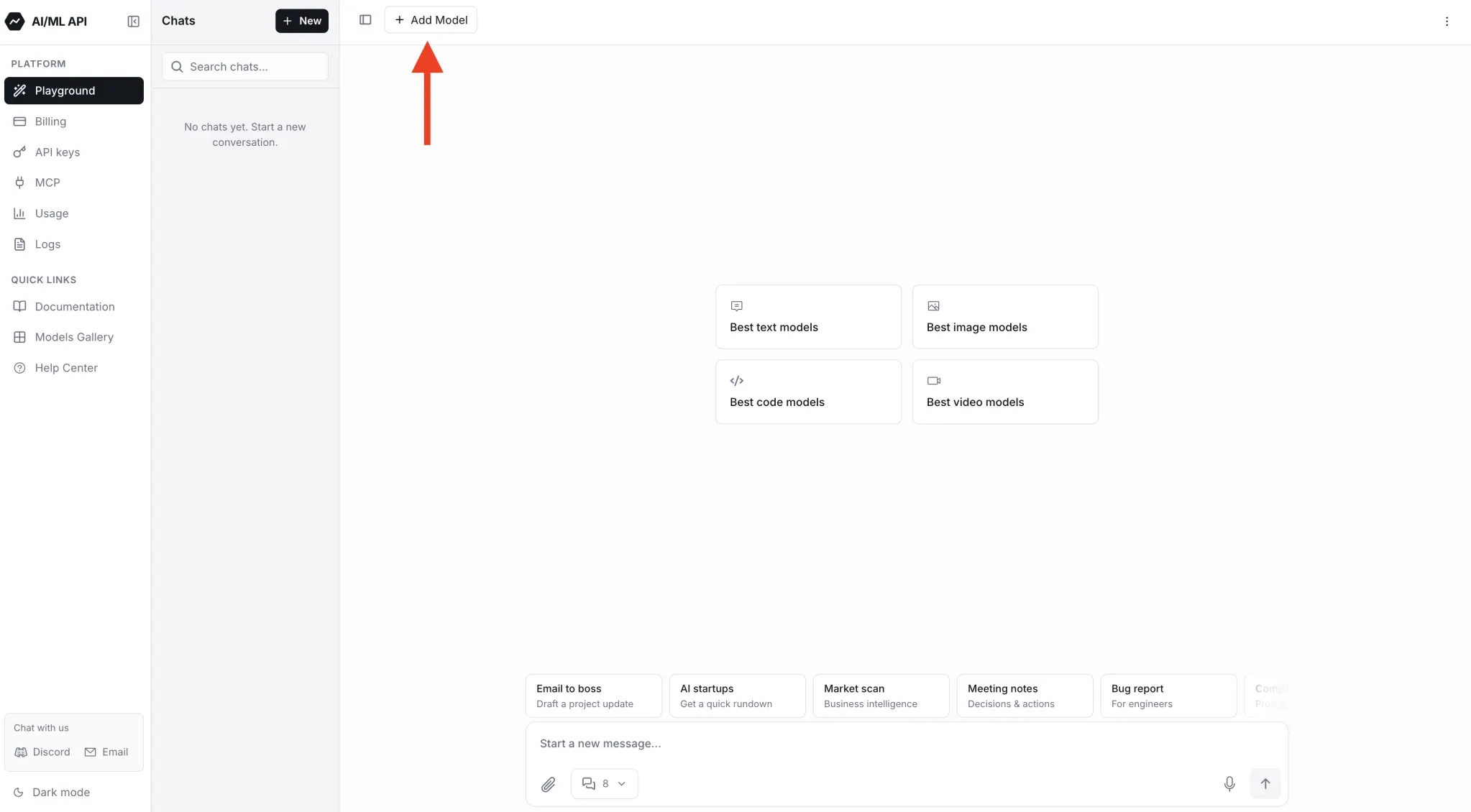
- Click Add Model at the top of the page.
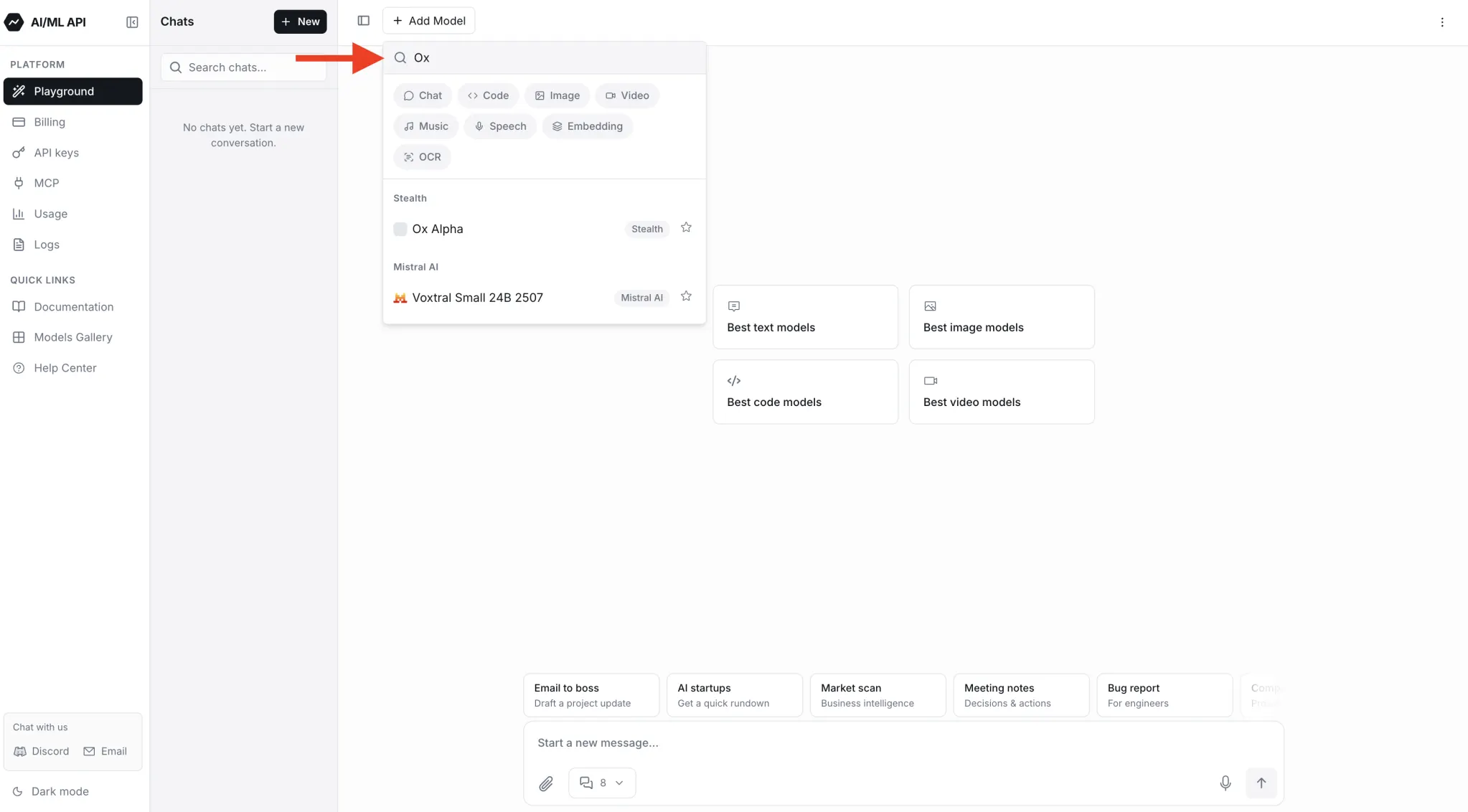
- Enter Ox in the model search box.
- Select Ox Alpha under Stealth.
- Enter a prompt in the message box and send it.
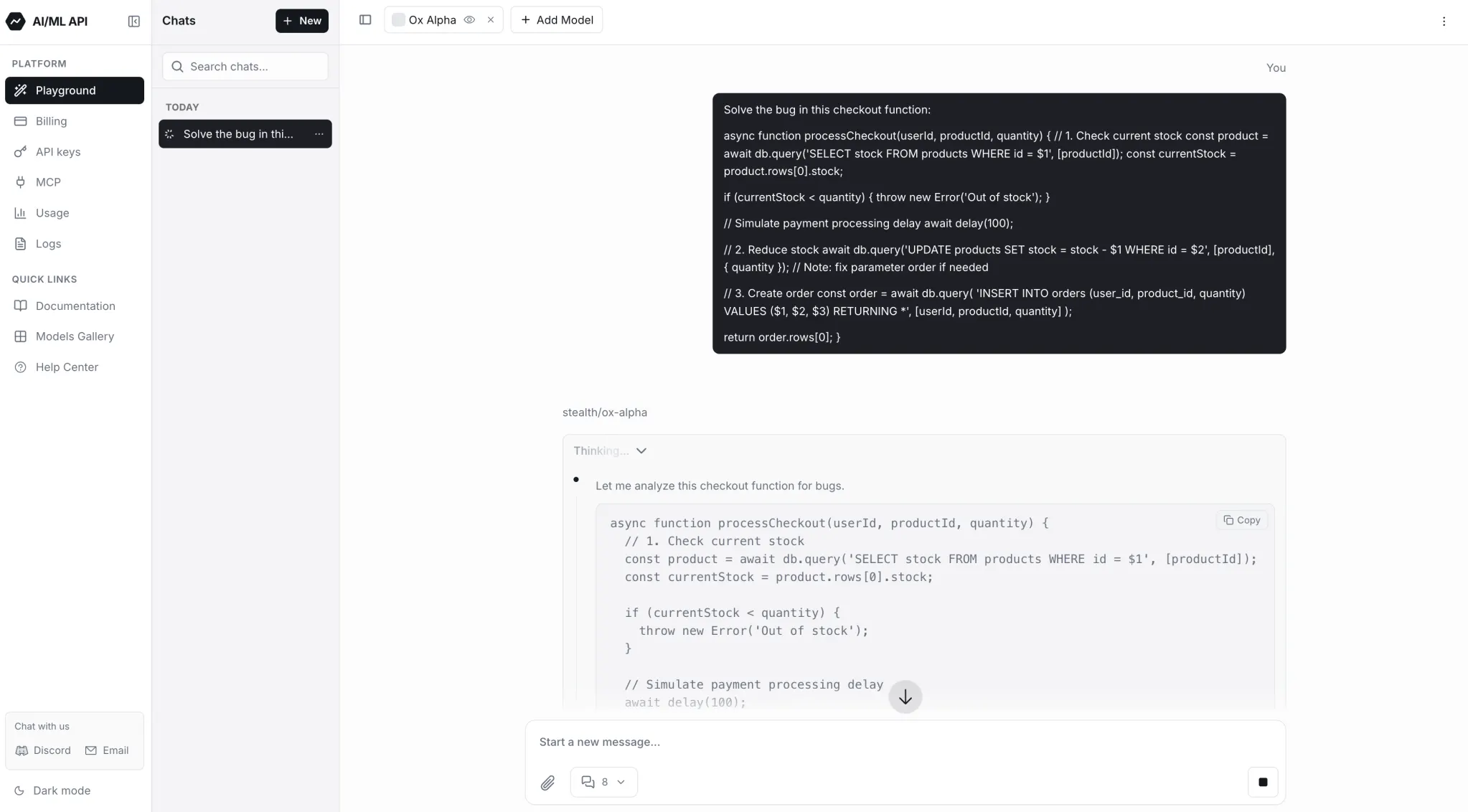
The Playground limits prompts to 5,000 characters and exposes only basic settings. Use the API for larger inputs, automated tests, tool calling, or application integration.
Option 2: Call Ox Alpha through the API
1. Create an API key
Open API keys, click Create API Key, and make sure the key is enabled. Store it in an environment variable. Do not put the key in browser code or commit it to a repository.
On macOS or Linux:
export AIMLAPI_KEY="YOUR_AIMLAPI_KEY"On Windows PowerShell:
$env:AIMLAPI_KEY="YOUR_AIMLAPI_KEY"2. Send a request
Ox Alpha uses the OpenAI-compatible Chat Completions endpoint:
POST https://api.aimlapi.com/v1/chat/completionsFor the full schema, see the Ox Alpha API reference.
Every request needs two fields:
| Field | Value |
|---|---|
model | stealth/ox-alpha |
messages | The conversation, including at least one user message |
Run this command in a terminal:
curl -L --request POST \
  --url "https://api.aimlapi.com/v1/chat/completions" \
  --header "Authorization: Bearer $AIMLAPI_KEY" \
  --header "Content-Type: application/json" \
  --data '{
    "model": "stealth/ox-alpha",
    "messages": [
      {
        "role": "user",
        "content": "Review this checkout workflow for race conditions. Explain the bug, then return a safe implementation."
      }
    ],
    "temperature": 0,
    "max_completion_tokens": 2000
  }'
You can also set temperature to control randomness and max_completion_tokens to limit the combined reasoning and answer length.
3. Check the response
A successful response contains a choices array. Read the answer from:
choices[0].message.contentAlso check choices[0].finish_reason. A value of stop means the model finished normally. A value of length means it reached max_completion_tokens; increase the limit or request a shorter answer.
FAQ
Is the model called Ox Alpha or 0x Alpha?
The model is called Ox Alpha, with the letter O, not 0x Alpha with a zero. The name causes confusion because 0x commonly marks hexadecimal numbers, but the official model ID is stealth/ox-alpha.
Is Ox Alpha free?
Ox Alpha currently costs $0 per million input and output tokens during its preview, although API access still requires a provider key. The provider may change the price, limits, or availability without notice, so treat the free access as temporary.
Does Ox Alpha retain my code?
Data handling depends on the route. OpenRouter says the provider retains prompts and completions but does not use them for training, while OpenCode Zen lists zero data retention and no training. Do not send private code, secrets, personal data, or regulated information unless the policy for your chosen route allows it.
Was Ox Alpha developed by Microsoft?
Microsoft was an early candidate, but current technical evidence points more strongly to Zhipu AI, also known as Z.ai. Ox Alpha counted all tokenizer probes exactly like GLM-5.2 and GLM-5.3, and researchers also found error messages associated with Z.ai’s infrastructure.
Is Ox Alpha better than Claude or GPT for coding?
Ox Alpha does not beat Claude or GPT across coding tests. It led an early ten-task sample with 80%, but scored 58.4% on the full DeepSWE run; the official leaderboard lists Claude Opus 5 at 74% and GPT-5.6 Sol at 73%. Ox Alpha remains useful for free experiments, but the larger test gives Claude and GPT the stronger results.
Bottom line
Ox Alpha is a stealth model for coding and agentic workflows, allegedly developed by Z AI. It is free during preview, accepts text, images, and video, and provides a roughly one-million-token context window through an OpenAI-compatible API. Here are the key takeaways:
Key takeaways
- Ox Alpha is best suited to coding and agentic work. Ox Alpha can analyze repositories, debug across multiple files, review large documents, use tools, and maintain context across long workflows.
- The model provides a roughly one-million-token context window, produces up to about 128K tokens, and accepts text, images, and video.
- Access is OpenAI-compatible. Use the model ID
stealth/ox-alphawith the Chat Completions API and keep the Bearer API key in a server-side environment variable. - Free access is likely temporary. The provider may change the model's price, limits, routing, latency, or availability, and its developer remains unconfirmed.
- Users can access Ox Alpha on AI/ML API through our OpenAI-compatible endpoint.