GPT-5.1 is an advanced iteration of the GPT-5 family by OpenAI. It improves on conversational quality, adaptive reasoning, and instruction-following capability, positioning itself as a more intelligent and user-friendly large language model suited for a variety of practical AI applications.
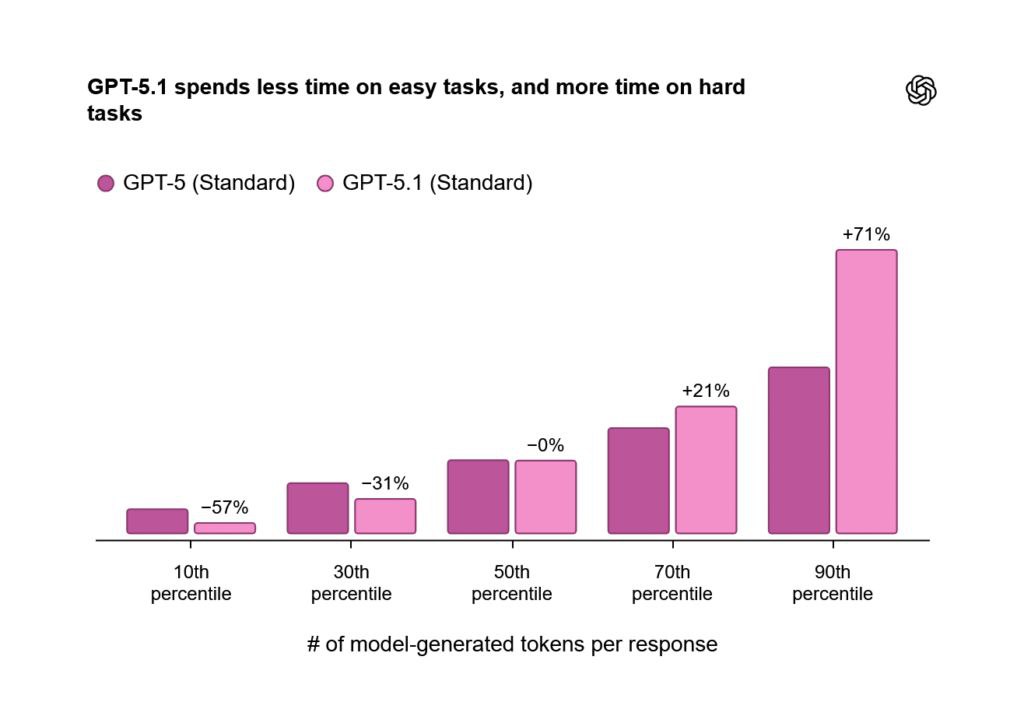
Users report GPT-5.1 excels in maintaining coherent narratives over extended conversations with fewer contradictions. Its outputs balance creativity and reliability, yielding precise, contextually-aware responses with strong adherence to factual information.
GPT-5.1 is ideally suited for professional and research applications requiring deep reasoning, complex coding assistance, and multimodal content analysis. Its adaptability makes it valuable for interactive AI agents, automated research assistants, and creative collaborations.
vs GPT-5: GPT-5.1 brings significant improvements in conversational warmth, adaptive reasoning, and instruction following compared to GPT-5. It features two specialized variants, Instant for fast, natural chat and Thinking for deep reasoning, while GPT-5 uses a single balanced model approach.
vs GPT-5 Pro: While GPT-5 Pro remains the highest-capability variant (for ultra-deep reasoning tasks), GPT-5.1 puts many of those advances into a more broadly accessible consumer model, offering near-top performance with more usability for everyday tasks.
vs Claude Sonnet 4.5: Claude 4.5 leads in coding reliability and lower hallucination rates, making it ideal for safety-critical and detailed technical tasks. GPT-5.1 outperforms Claude in conversational warmth and adaptive reasoning flexibility, delivering faster responses for everyday use and more personalized interactions.
Highlights include its smoother handling of long conversations and improved factual consistency. Some developers admire the balance it strikes between reasoning complexity and responsiveness, making it preferred for multi-domain AI agent development.
Measured on the AI/ML API gateway across live traffic. Figures are medians unless stated. Last updated 2026-10-12.
import requests

r = requests.post(
    "https://api.aimlapi.com/v1/chat/completions",
    headers={"Authorization": "Bearer " + AIMLAPI_KEY},
    json={
      "model": "openai/gpt-5-1",
      "messages": [
        {
          "role": "user",
          "content": "Hello!"
        }
      ]
    },
)
print(r.json())
const r = await fetch("https://api.aimlapi.com/v1/chat/completions", {
  method: "POST",
  headers: {
    Authorization: `Bearer ${process.env.AIMLAPI_KEY}`,
    "Content-Type": "application/json",
  },
  body: JSON.stringify({
    "model": "openai/gpt-5-1",
    "messages": [
      {
        "role": "user",
        "content": "Hello!"
      }
    ]
  }),
});
console.log(await r.json());
curl -X POST https://api.aimlapi.com/v1/chat/completions \
  -H "Authorization: Bearer $AIMLAPI_KEY" \
  -H "Content-Type: application/json" \
  -d '{"model":"openai/gpt-5-1","messages":[{"role":"user","content":"Hello!"}]}'
OpenAI-compatible — swap the base URL and it works with your existing SDK.
| Type | Price |
|---|---|
| Input | |
| Output | |
| Cached input |
| Benchmark | Score | What it measures | Source | Retrieved |
|---|---|---|---|---|
| SWE-bench Verified | 76.3% | Resolving verified real GitHub issues | Source | July 12, 2026 |
| GPQA Diamond | 88.1% | Google-proof graduate science questions (hardest subset) | Source | July 12, 2026 |
| Intelligence | 24.7 | Composite score across standardised reasoning, knowledge and problem-solving evaluations, measured independently by Artificial Analysis | Source | September 12, 2026 |
| Coding | 49.4 | Composite score across standardised coding evaluations, measured independently by Artificial Analysis | Source | September 12, 2026 |
| Math | 94 | Composite score across standardised mathematics evaluations, measured independently by Artificial Analysis | Source | September 12, 2026 |
| Model | Input | Output | Context | Best for |
|---|---|---|---|---|
GPT-5.1 This page | Reasoning + agents | |||
| Reasoning + agents | ||||
| Balanced coding + agents | ||||
| Long-context, multimodal & agentic workflows | ||||
| Reasoning + agents |
GPT-5.1 has a 400,000 tokens context window and can return up to 128,000 tokens.
GPT-5.1 takes image, text as input and returns text.
Use openai/gpt-5-1 as the model id. Requests go to https://api.aimlapi.com/v1/chat/completions.
GPT-5.1 is priced at input $1.625 / 1M tokens, output $13 / 1M tokens, cached input $0.1625 / 1M tokens.
Yes, GPT-5.1 can stream responses as they are generated.
Yes, GPT-5.1 accepts image input alongside text.
GPT-5.1 was built by OpenAI.
Send requests to https://api.aimlapi.com/v1/chat/completions using the model id openai/gpt-5-1.
Yes, it supports function calling, parallel tool calls, and structured outputs.