Perplexity’s Sonar is a high-speed AI assistant built for real-time, context-sensitive search and synthesis, delivering accurate, cited answers for both professional and everyday use by combining rapid information retrieval with robust reasoning over multiple sources.
Sonar rapidly retrieves and synthesizes information from diverse sources, delivering clear, cited answers that set a benchmark for real-time research and analytics.
Perplexity Sonar Description
Perplexity AI’s Sonar is an advanced multimodal AI assistant optimized for real-time, context-aware web search, synthesis, and conversational analytics. Designed for both professional and consumer workflows, Sonar combines fast, authoritative information retrieval with robust reasoning over retrieved documents.
Technical Specification
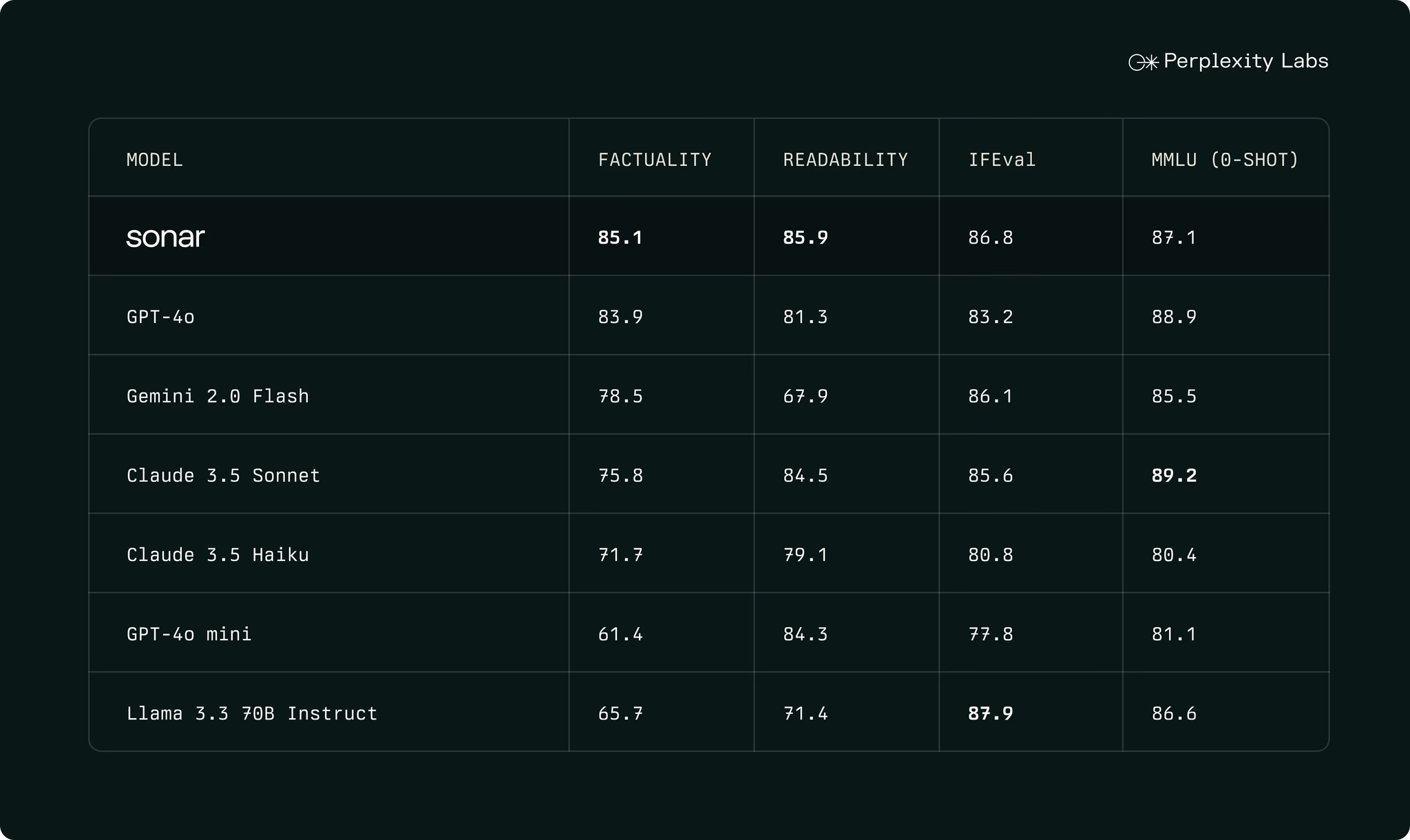
Performance Benchmarks
Model Architecture: Hybrid system combining proprietary and open-source LLMs (LlaMa 3.1 70B base, custom Perplexity fine-tuning), with integrated real-time web search and multi-document synthesis.
Context Window: Dynamic, automatically adjusts to the retrieved content and query complexity.
Tool Integration: Native live web search, academic databases, and citation engine for source-backed answers.
Performance Metrics
Sonar demonstrates consistency in real-time information retrieval and source-backed answer quality. Its upward trend in query volume and user engagement signals strong market fit for knowledge-intensive workflows. The trade-off for rapid, cited answers is slightly higher latency compared to pure LLM chatbots, but with greater accuracy and transparency.
API Pricing
Input: $1.3 per million tokens
Output: $1.3 per million tokens
Key Capabilities
Perplexity Sonar API delivers authoritative outputs for information-dense workflows.
Advanced Search & Synthesis: Excels in cross-referencing multiple web sources, distilling complex information, and presenting it with clarity and transparency.
Conversational Analytics: Supports multi-turn, context-aware dialogues for research, business intelligence, and decision support.
Tool Utilization: Integrates proprietary live web search, enabling real-time fact-checking and source citation.
Code Sample
Comparison with Other Models
Vs. Claude 4 Opus: Sonar specializes in live, cited answers from the web, while Claude 4 Opus leads in autonomous coding, reasoning, and agentic workflows. Sonar is optimized for users who need answers grounded in the latest, most authoritative sources rather than long-context reasoning or code generation.
Vs. Gemini 2.5: Sonar emphasizes real-time search and synthesis; Gemini models offer broad multimodal capabilities and long-context reasoning but may not always surface citations or real-time data as explicitly.
Vs. OpenAI GPT-4: Perplexity Sonar is purpose-built for retrieval-augmented generation (RAG) and source transparency; GPT-4 is a generalist model, best for broad reasoning and creative tasks without built-in web sourcing.
Limitations
Perplexity/Sonar specializes in real-time research, multi-source synthesis, and cited analytics, setting it apart for up-to-date, accurate, and verifiable answers. However, its limitations are equally distinctive:
No Traditional Coding or Reasoning Benchmarks: Unlike models such as Claude Opus 4 or Kimi K2, Perplexity Sonar does not publish standard coding or reasoning metrics (e.g., SWE-bench, LiveCodeBench) because its architecture is optimized for real-time, sourced knowledge retrieval rather than autonomous coding or long-horizon reasoning
Best for Research and Analytics, Not Code: It excels in tasks requiring live web search, deep citation, and business intelligence, but is less suitable for pure code generation, agentic autonomy, or scenarios where generative program synthesis is critical.
Static Knowledge and Reasoning: For tasks beyond the scope of its search-embedded, live-updated knowledge, Perplexity Sonar operates like any RAG (Retrieval-Augmented Generation) system: without real-time, cited web access, it cannot claim dramatic accuracy or recency advantages over other frontier models.
API Integration
Accessible via AI/ML API. Documentation: available here
Perplexity AI’s Sonar is an advanced multimodal AI assistant optimized for real-time, context-aware web search, synthesis, and conversational analytics. Designed for both professional and consumer workflows, Sonar combines fast, authoritative information retrieval with robust reasoning over retrieved documents.
Technical Specification
Performance Benchmarks
Model Architecture: Hybrid system combining proprietary and open-source LLMs (LlaMa 3.1 70B base, custom Perplexity fine-tuning), with integrated real-time web search and multi-document synthesis.
Context Window: Dynamic, automatically adjusts to the retrieved content and query complexity.
Tool Integration: Native live web search, academic databases, and citation engine for source-backed answers.
Performance Metrics
Sonar demonstrates consistency in real-time information retrieval and source-backed answer quality. Its upward trend in query volume and user engagement signals strong market fit for knowledge-intensive workflows. The trade-off for rapid, cited answers is slightly higher latency compared to pure LLM chatbots, but with greater accuracy and transparency.
API Pricing
Input: $1.3 per million tokens
Output: $1.3 per million tokens
Key Capabilities
Perplexity Sonar API delivers authoritative outputs for information-dense workflows.
Advanced Search & Synthesis: Excels in cross-referencing multiple web sources, distilling complex information, and presenting it with clarity and transparency.
Conversational Analytics: Supports multi-turn, context-aware dialogues for research, business intelligence, and decision support.
Tool Utilization: Integrates proprietary live web search, enabling real-time fact-checking and source citation.
Code Sample
Comparison with Other Models
Vs. Claude 4 Opus: Sonar specializes in live, cited answers from the web, while Claude 4 Opus leads in autonomous coding, reasoning, and agentic workflows. Sonar is optimized for users who need answers grounded in the latest, most authoritative sources rather than long-context reasoning or code generation.
Vs. Gemini 2.5: Sonar emphasizes real-time search and synthesis; Gemini models offer broad multimodal capabilities and long-context reasoning but may not always surface citations or real-time data as explicitly.
Vs. OpenAI GPT-4: Perplexity Sonar is purpose-built for retrieval-augmented generation (RAG) and source transparency; GPT-4 is a generalist model, best for broad reasoning and creative tasks without built-in web sourcing.
Limitations
Perplexity/Sonar specializes in real-time research, multi-source synthesis, and cited analytics, setting it apart for up-to-date, accurate, and verifiable answers. However, its limitations are equally distinctive:
No Traditional Coding or Reasoning Benchmarks: Unlike models such as Claude Opus 4 or Kimi K2, Perplexity Sonar does not publish standard coding or reasoning metrics (e.g., SWE-bench, LiveCodeBench) because its architecture is optimized for real-time, sourced knowledge retrieval rather than autonomous coding or long-horizon reasoning
Best for Research and Analytics, Not Code: It excels in tasks requiring live web search, deep citation, and business intelligence, but is less suitable for pure code generation, agentic autonomy, or scenarios where generative program synthesis is critical.
Static Knowledge and Reasoning: For tasks beyond the scope of its search-embedded, live-updated knowledge, Perplexity Sonar operates like any RAG (Retrieval-Augmented Generation) system: without real-time, cited web access, it cannot claim dramatic accuracy or recency advantages over other frontier models.
API Integration
Accessible via AI/ML API. Documentation: available here





.webp)

.webp)




.png)


.png)
